





Vietnam's Industrial Parks After the 2025 Reorganization: A National Outlook
Vietnam's industrial property map has just been redrawn, not by new factories or master plans, but by a stroke of administrative reform. On July 1, 2025, the government's most sweeping territorial restructuring since reunification took effect, collapsing the country's 63 provinces and centrally governed cities into 34. For an industrial sector that has spent two decades organizing itself around provincial boundaries, including provincial investment incentives, provincial labor pools, and provincial industrial park master plans, the question now is simple: what does the map actually look like, and where does that leave investors trying to read it?
The Scale of the Reform
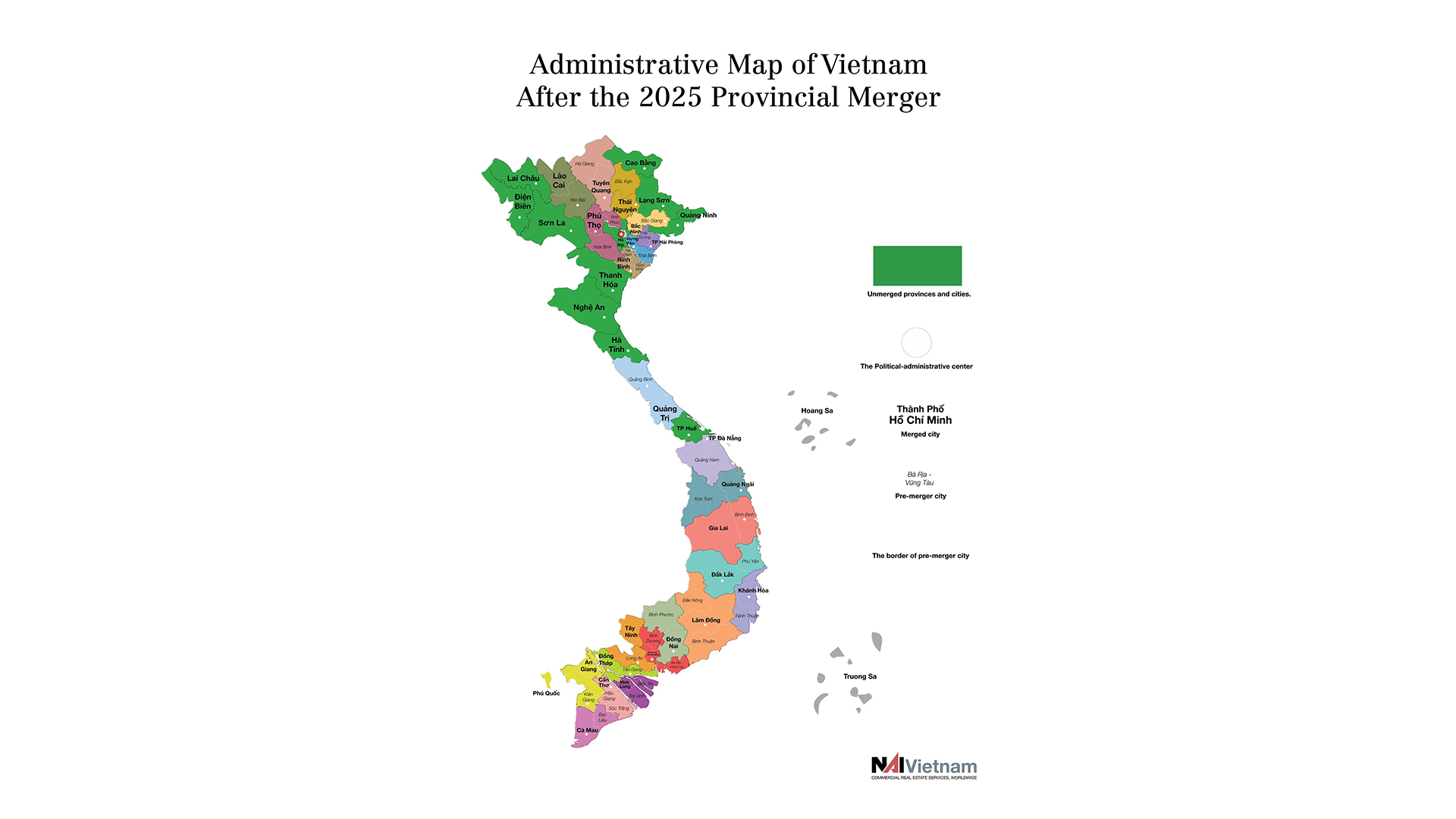
The reorganization was enacted under Government Decision No. 759/QD-TTg, signed on April 14, 2025, and it goes considerably further than a simple renumbering exercise. District-level administration, the layer of counties, towns, and district-level cities that has long sat between provinces and communes, has been abolished outright, leaving a two-tier system of provinces and centrally governed cities above, and communes, wards, and special administrative zones below. At the grassroots level, the consolidation of communes and wards is estimated to have reduced the number of these units by 60 to 70 percent. Eleven provinces and cities, including Hanoi and Ho Chi Minh City, were left unchanged; the remaining 23 new units were formed by merging two or three former provinces around a single administrative center.
It is worth putting this in historical context. Vietnam last redrew its map at this scale in 1976, when the post-reunification government consolidated 72 provinces into 38. The 63-province structure that most investors, developers, and site selectors have worked with for their entire careers has only been in place since 2008. In other words, the operating assumptions baked into a generation of industrial park benchmarking, including which province has cheaper land, which has a faster customs office, and which has the deeper labor pool, now need to be re-tested against a fundamentally different administrative geometry.
What the New Numbers Show
Stripped of the political narrative, the reorganization leaves behind a dataset that tells its own story. Across the 34 new units, Vietnam now counts roughly 101.1 million people and a labor force of approximately 68.1 million, against cumulative registered FDI of around US$511.5 billion. Three macro-regions emerge from the new boundaries, each with a distinct profile.
The northern region, encompassing Hanoi, Bac Ninh, Hai Phong, Hung Yen, Quang Ninh, and the broader delta and midland provinces, covers about 116,464 square kilometers, is home to roughly 37.2 million people and 24 million workers, and has absorbed approximately US$207 billion in cumulative FDI. The southern region is smaller in land area, at roughly 64,474 square kilometers, but carries a comparable population of 36.7 million and a slightly larger labor force of 26.4 million, while leading the country in FDI with approximately US$231 billion. The central region, by contrast, is the largest by territory at 150,397 square kilometers but the lightest in both population (27.2 million) and FDI (US$73 billion), a gap that is less a sign of weakness than an indicator of where the next decade of industrial expansion has room to happen.
Explore the 34 Provinces by Region
The chart below breaks down area, population, labor force, and cumulative FDI for every province and city under the new structure. Click a region to see the full province-level detail.
Figures rounded. See full data sources at the end of this article.
The FDI Concentration Problem
Look at where capital has actually landed, and the picture sharpens further. Ho Chi Minh City alone accounts for roughly 27 percent of the nation's cumulative FDI, a single administrative unit, newly enlarged through its merger with Binh Duong and Ba Ria-Vung Tau, holding more registered foreign capital than the next four provinces combined. Bac Ninh, Dong Nai, Hai Phong, and Hanoi each sit in the 8.5 to 8.8 percent range, forming a second tier of established industrial heavyweights. Beyond that, the drop off is steep: Tay Ninh, newly merged with Long An, holds under 5 percent; Quang Ninh, Thanh Hoa, Hung Yen, and Ninh Binh round out the top ten with shares between roughly 2.6 and 3.2 percent each.
The practical implication is that five provinces, Ho Chi Minh City, Bac Ninh, Dong Nai, Hai Phong, and Hanoi, now account for more than half of all foreign capital ever invested in the country. For industrial real estate and logistics services, these remain the highest priority markets almost by default, given their deep infrastructure, established supply chains, and tenant bases that are already committed. But for the same reason, they are also the markets where land scarcity and rising costs are most acute, and where the upside of the reorganization, in theory bigger contiguous administrative units and simpler permitting, is least likely to translate into cheaper or faster project delivery.
Where the Reorganization Creates New Opportunity
The more interesting story is in the second and third tiers. Tay Ninh's jump up the FDI rankings is a direct product of its merger with Long An, effectively stitching Ho Chi Minh City's southwestern industrial corridor into a single, larger administrative unit. It is a textbook case of the reform creating a market that did not quite exist in its current form before July 2025. Similar logic applies in the center of the country, where Da Nang's merger with Quang Nam, and Khanh Hoa's merger with Ninh Thuan, create larger coastal units better positioned to compete for tourism adjacent and light manufacturing investment that previously had to be evaluated province by province.
The central region as a whole is the clearest argument for a longer investment horizon. With the lowest population density and FDI per capita of the three macro-regions, but the largest land bank, it is the part of the country where industrial land remains genuinely available, and, as later installments in this series will show, where minimum wage costs are also structurally lower than in the north or south. For investors and developers willing to do the market education work, explaining infrastructure roadmaps, land availability, and labor supply to tenants who have defaulted to Hanoi, Bac Ninh, or Ho Chi Minh City out of habit, the reorganized central provinces are arguably the most underwritten opportunity in the country today.
What Comes Next
This piece sets the baseline: a country reorganized into 34 provinces, a labor force of 68 million, and over half a trillion dollars of cumulative FDI concentrated in five markets out of thirty four. The remaining articles in this series will move from this national altitude down to the ground level, examining the northern industrial corridor anchored by Hanoi, Bac Ninh, and Hai Phong; the underexplored central provinces stretching from Thanh Hoa to Khanh Hoa; the southern engine room built around Ho Chi Minh City, Dong Nai, and the newly expanded Tay Ninh; and finally, a dedicated look at how regional minimum wage tiers are likely to shape where the next wave of labor-intensive manufacturing actually lands.
- Based on Government Decision No. 759/QD-TTg (April 14, 2025), compiled by our company.
- Area: Calculated by our company based on data from the General Statistics Office of Viet Nam (2024).
- Population & labor force: Calculated by our company based on data from the General Statistics Office of Viet Nam (2024).
- Accumulated FDI approvals: Compiled by our company based on data from the Ministry of Planning and Investment of Viet Nam (as of March 2025).