





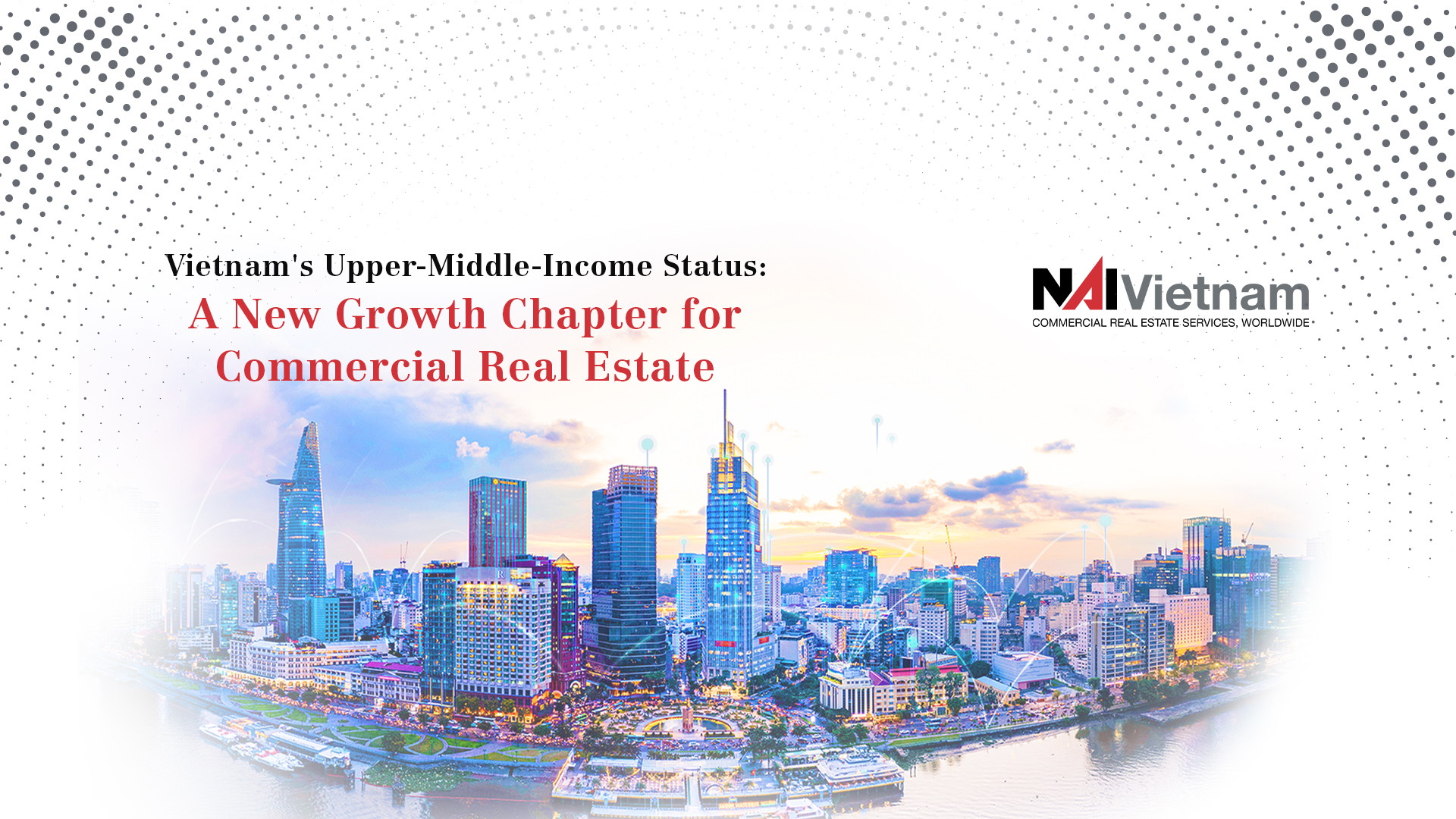
Vietnam has reached another significant economic milestone. Effective from July 2026, the World Bank has officially classified Vietnam as an upper-middle-income economy, reflecting the country's sustained economic expansion, rising productivity and improving national income over recent years. The new classification is based on Vietnam's Gross National Income (GNI) per capita surpassing the World Bank's upper-middle-income threshold.
While this milestone is symbolic from an economic standpoint, its implications extend far beyond macroeconomic statistics. For the commercial real estate sector, it signals a structural transformation in the type of investment, occupier demand and real estate products that will define Vietnam's next growth cycle.
At NAI Vietnam, we believe this transition represents a pivotal moment — not because the market changes overnight, but because global investors and corporate occupiers increasingly view Vietnam through a different lens.
Vietnam's Atlas-method GNI per capita rose from US$3,540 in 2021 to US$4,970 in 2025, crossing the World Bank's US$4,636 upper-middle-income threshold and triggering the reclassification effective July 2026.
Is your real estate strategy positioned for a Vietnam that competes on quality, not just cost?
From Cost Advantage to Competitive Advantage
For decades, Vietnam's growth story has been built on competitive manufacturing costs, a young workforce and export-driven industrialization. Today, the country's value proposition is evolving. As Vietnam advances into the upper-middle-income category, international businesses are increasingly selecting the market not solely for cost efficiency, but for its ability to support long-term regional operations, innovation and business expansion.
This evolution will attract a broader range of occupiers, including:
- Regional headquarters
- Financial services
- Technology companies
- Professional services firms
- Research & Development (R&D)
- Advanced manufacturing
- Semiconductor and electronics supply chains
- Business support services
Consequently, commercial real estate must evolve alongside these changing business requirements.
Office Market: Quality Will Outperform Quantity
One of the most immediate impacts will be seen in Vietnam's office market. Corporate occupiers are becoming increasingly sophisticated in their workplace strategies. Leasing decisions are no longer driven solely by rental costs but by the workplace's ability to attract talent, improve employee wellbeing and support operational efficiency.
NAI Vietnam expects continued demand growth for:
- Grade A office buildings
- ESG-certified developments
- Smart buildings with integrated digital management
- WELL-focused workplaces
- Mixed-use business destinations
- Transit-oriented developments
In this environment, premium office assets become strategic business infrastructure rather than simply office space. Developers that invest in building quality, sustainability and tenant experience will likely be better positioned to capture future demand.
Industrial Real Estate Moves Up the Value Chain
Industrial real estate remains one of Vietnam's strongest-performing asset classes. However, the country's competitive positioning is changing. Rather than competing primarily on labor-intensive manufacturing, Vietnam is increasingly attracting industries that require higher-value production, advanced infrastructure and resilient supply chains. These sectors include:
- Electronics
- Precision engineering
- Medical devices
- Semiconductor manufacturing
- Green manufacturing
- Modern logistics
As a result, occupier demand is expected to shift toward:
- Ready-built factories
- Build-to-suit facilities
- Grade A logistics warehouses
- High-specification industrial parks
- ESG-compliant industrial developments
Industrial developers will increasingly compete through infrastructure quality, sustainability credentials, power reliability and operational efficiency rather than land cost alone.
Retail Real Estate Will Benefit from Rising Consumer Spending
An upper-middle-income economy also reflects growing household purchasing power and an expanding middle class. This creates favorable conditions for modern retail formats, lifestyle destinations and experiential shopping environments. Consumers are becoming increasingly selective, prioritizing convenience, premium experiences and integrated lifestyle offerings. Developers should expect stronger demand for:
- Mixed-use developments
- Destination retail
- Food & beverage concepts
- Lifestyle centers
- Entertainment-driven retail
- Community-oriented commercial projects
Retail success will increasingly depend on customer experience rather than simply tenant mix.
Investment Market: Institutional Capital Becomes More Active
The new income classification enhances Vietnam's credibility among global institutional investors. International capital increasingly seeks markets that demonstrate:
- Political stability
- Strong economic fundamentals
- Transparent regulatory improvements
- Infrastructure investment
- Sustainable long-term growth
- Attractive demographic trends
Vietnam now meets many of these investment criteria. NAI Vietnam anticipates continued interest from:
- Global real estate funds
- Institutional investors
- Pension funds
- Insurance capital
- Private equity
- Cross-border joint ventures
Investment activity is expected to concentrate on institutional-grade assets capable of generating stable long-term income, particularly within the office and industrial sectors.
ESG Is Becoming a Market Standard
One of the defining characteristics of mature commercial real estate markets is the growing importance of Environmental, Social and Governance (ESG) performance. As multinational corporations continue expanding in Vietnam, sustainability requirements are becoming embedded within leasing and investment decisions. Occupiers increasingly evaluate buildings based on:
- Green building certifications
- Energy efficiency
- Carbon reduction strategies
- Employee wellbeing
- Smart building technologies
- Long-term operational resilience
Buildings that integrate ESG principles are likely to achieve stronger occupancy, greater tenant retention and enhanced asset value over time. For landlords, ESG is no longer simply a marketing advantage — it is becoming a core component of asset competitiveness.
Opportunities for Developers and Occupiers
Vietnam's new economic status creates opportunities across the commercial real estate ecosystem. For developers, the focus should shift toward delivering higher-quality assets aligned with evolving occupier expectations. For corporate occupiers, workplace and facility decisions should increasingly support talent attraction, operational resilience and long-term business growth.
For investors, Vietnam's structural fundamentals continue to support long-term capital deployment across:
- Office
- Industrial
- Logistics
- Mixed-use sectors
Success in this next phase will depend less on acquiring assets at the lowest cost and more on identifying properties capable of delivering sustainable value over the long term.
NAI Vietnam's Outlook
Vietnam's transition to an upper-middle-income economy marks more than an economic achievement — it signals the beginning of a more sophisticated commercial real estate market. As businesses expand, industries modernize and institutional capital becomes increasingly active, demand will continue shifting toward higher-quality commercial assets that support productivity, sustainability and long-term growth.
At NAI Vietnam, we believe the next decade will be defined not by the quantity of new developments, but by the quality of commercial environments that enable businesses to thrive. Developers, investors and occupiers who recognize this structural shift today will be best positioned to capture the opportunities emerging in Vietnam's next chapter of economic development.
Position Your Portfolio for Vietnam's Next Chapter of Growth
Connect with NAI Vietnam to explore how the upper-middle-income transition will shape office, industrial, retail and investment strategy across your portfolio.
Sources
- World Bank. GNI per capita, Atlas method (current US$) — Viet Nam, 2021–2025.
- World Bank. FY2027 country income classification, effective July 1, 2026.