





Executive summary
Vietnam’s commercial real estate (CRE) market demonstrated broad-based resilience in 2025. Despite mixed performance across asset classes, overall momentum was underpinned by robust macroeconomic growth, rising foreign direct investment (FDI), and sustained demand for quality space. Office fundamentals softened amid new supply introductions, while the retail sector showed stable performance with rising rents and occupancy. Industrial real estate remained the strongest segment, reinforced by high occupancy in established industrial parks and ongoing manufacturing expansion. With major infrastructure projects slated for 2026, Vietnam continues to attract strategic capital, positioning its CRE market for measured growth in the coming year.

Macro-economic environment
Vietnam’s economy maintained strong performance in 2025, with GDP expected to reach approximately 8.02% – one of the highest growth rates in Southeast Asia. For the first time, our GDP exceeds USD 500 billion. Preliminary reports indicate continued quarterly momentum, with industrial production recording significant expansion as manufacturers ramped up output to meet year-end demand. The Index of Industrial Production rose by 8.95% YoY, largely contributed to the strongest full-year industrial expansion since 2020.
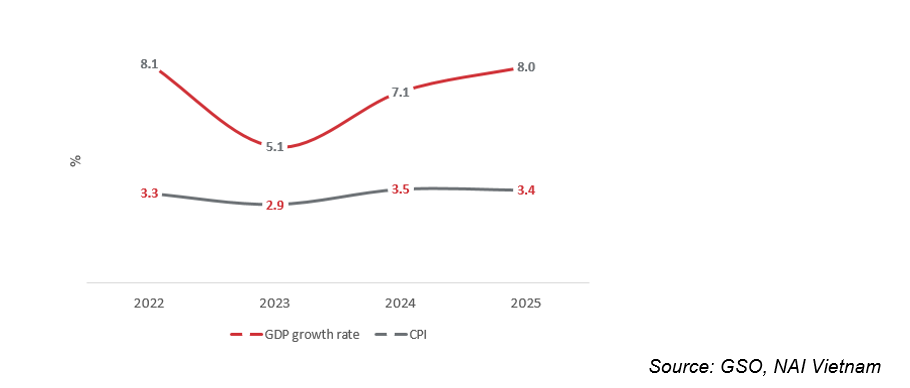
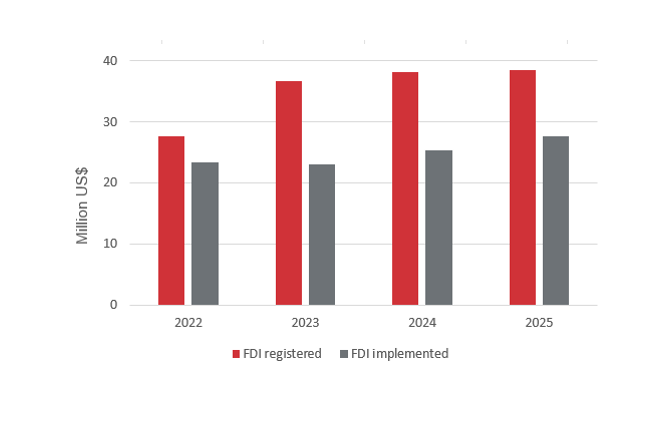
Total foreign direct investment also strengthened, with total FDI surpassing USD 38.42 billion, a record high in many years. Singapore and China remained the largest sources of capital, leading investments into manufacturing, real estate, and high-tech industrial parks. Hong Kong, Japan and Sweden followed, with funding increasingly directed toward supporting industries, logistics, and consumer-oriented sectors. Vietnam continues its attractiveness as a strategically positioned economy for both production and capital deployment.
Recent policy reforms, especially Resolution 254/2025/QH15 and related decrees on land pricing, decentralization, and land-use fee reductions, are expected to materially improve project timelines, lower development risk and strengthen the medium-term outlook for Vietnam’s CRE market. In addition, the 2025 provincial mergers, which expanded the administrative and economic footprint of major hubs such as Ho Chi Minh City, are reshaping CRE dynamics by consolidating demand into larger metropolitan cores, improving regional planning efficiency, and accelerating the absorption of office, retail, and logistics space in newly integrated growth corridors.
Looking into 2026 and beyond, key infrastructure projects such as Long Thanh International Airport, the high-speed North-South railway and other major highways are expected to further bolster logistics connectivity and industrial competitiveness. At the beginning of 2026, Long Thanh International Airport had reached approximately 63.6% of overall construction progress by contract value, with key components such as the first runway and passenger terminal largely completed, with the target for full Phase 1 commercial operations in June 2026. With a comprehensive pipeline of projects scheduled for completion and rollout during 2026–2030, Vietnam’s expressway network is expected to exceed 5,500 km by 2030, acting as a strategic infrastructure catalyst for economic growth and real estate development nationwide.
Office – Selective softening amid growth dynamics
In Ho Chi Minh City (HCMC), the office market recorded stable yet growing supply in 2025 to over 1.7 million square meters. Despite supply additions, key performance metrics showed softening, particularly for Grade A assets. Average net rental rate declined by 1.4% YoY, settling at USD 58.4/sqm/month. Occupancy decreased to 87.3%, down 2.3 percentage points YoY. This moderation is largely attributed to new supply needing time to stabilize and attract tenants, a typical trend in markets with increasing completions. Grade B assets held rents at around USD 35.6/sqm/month, rising 1.1% YoY, with occupancy at 88.3% — a slight contraction of 1 ppt YoY.
ESG considerations are increasingly shaping Grade A leasing decisions, as more multinational tenants prioritise buildings with LEED, EDGE or Green Mark certifications in support of their Net-Zero commitments. Green assets continue to command stronger rental performance and occupancy, a clear shift from cost-based competition toward sustainability-led differentiation.
Post-merger dynamics among HCMC, Ba Ria–Vung Tau, and Binh Duong have driven several large office leases, as corporations consolidate operations into HCMC’s CBD. This trend toward centralization of quality space is expected to persist in early 2026, reinforcing demand for well-located, modern offices.

Retail – Rising occupancy and rental resilience
The retail sector in HCMC experienced supply stagnation by the end of 2025, with no new shopping center completions. As a result, total retail stock remained stable at approximately 1.1 million square meters.
Retail fundamentals strengthened late in the year with occupancy reached 95.4%, rising 5.6% YoY — a remarkable improvement in tenant retention and leasing activity. Average asking rents edged up to USD 55.8/sqm/month, reflecting a 2.2% YoY increase.
These trends reflect improving operator confidence, tighter effective supply, and sustained consumer demand, especially in food & beverage, lifestyle, and experiential segments.
Retail supply in HCMC is projected to remain constrained in 2026, with limited new mall completions anticipated. Market dynamics are expected to shift, particularly within the F&B sub-segment, where operators are optimizing costs by relocating from street-front locations to established shopping centers with consistent foot traffic.
Industrial – Strong demand and strategic depth
By end-2025, Vietnam had 478 established industrial parks (IPs) nationwide, spanning 146,000 ha of planned land. Of this, 324 IPs are currently in operation, accounting for 95,700 ha of land. This expansive and geographically diversified supply base underpins sustained industrial real estate demand.
Vietnam’s industrial sector recorded continued demand growth in 2025 with Import–export value exceeded USD 930 billion, an increase of 18.2% YoY, contributing to a robust trade surplus of USD 20 billion.
Sector growth was led by electronics, machinery, and processed food, which increasingly anchor manufacturing and industrial space needs.
Industrial parks maintained high occupancy, with an average rate of approximately 79.6% across operating IPs. High absorption reflects strong demand for ready-to-operate locations that offer logistical connectivity and scale, factors central to foreign direct manufacturing investments.
Industrial prospects remain strong for 2026, thanks to policy reforms and logistics infrastructure upgrades. Large-scale initiatives such as the proposed 3,800-ha Cai Mep Ha Free Trade Zone are poised to streamline customs and logistics operations, enhancing Vietnam’s allure as a regional manufacturing and trade hub.
Outlook for 2026
Entering 2026, Vietnam’s CRE market is expected to transition from cyclical recovery to structural repricing, driven not only by positive economic growth and infrastructure delivery, but also by a significant capital market milestone. In September 2026, Vietnam is scheduled to be officially reclassified by FTSE Russell from Frontier Market to Secondary Emerging Market. This upgrade is widely expected to unlock USD 5-6 billion of incremental inflows from global ETFs and actively managed funds over the first two to three years post-upgrade.
While the FTSE reclassification primarily affects equity markets, its second-order impacts on real estate are likely to be material. For CRE segments that have reached relative operational maturity, this upgrade acts as a confidence catalyst for investment.
If you would like to know more, please feel free to contact the Research Team at NAI Vietnam.
Hotline: +84 901 665 445
Email: info@naivietnam.com
This research has been prepared by NAI Vietnam for informational purposes only and should not be considered investment or legal advice.
This research report has been prepared independently and solely on the basis of publicly available information that NAI Vietnam considers to be reliable but NAI Vietnam has not independently verified the contents hereof. NAI Vietnam accepts no liability whatsoever for any direct or consequential loss, including without limitation any loss of profits, arising from reliance on this research report.
The opinions expressed herein are the opinions of the research analysts and reflect their opinion as of the date hereof. These opinions are subject to change and NAI Vietnam does not undertake to notify any recipient of this research report of any such change nor of any other changes related to the information provided in this research report.
This research report is protected by copyright and is intended solely for the designated addressee. It may not be reproduced or distributed, in whole or in part, by any recipient for any purpose without NAI Vietnam’s prior written consent.
+84 901 665 445 | info@naivietnam.com | naivietnam.com