




The proposed administrative integration of Ho Chi Minh City, Dong Nai, and Ba Ria – Vung Tau has the potential to reshape Southern Vietnam’s industrial landscape and create one of Southeast Asia’s most competitive manufacturing and logistics ecosystems.
From NAI Vietnam’s perspective, the merger represents more than an administrative change. It signals a strategic opportunity to align three critical components of the industrial value chain under one economic vision: commerce and talent, manufacturing capacity, and deep-sea port infrastructure.
From Fragmented Industrial Hubs to an Integrated Economic Region
Historically, Southern Vietnam’s industrial development has evolved across distinct geographies.
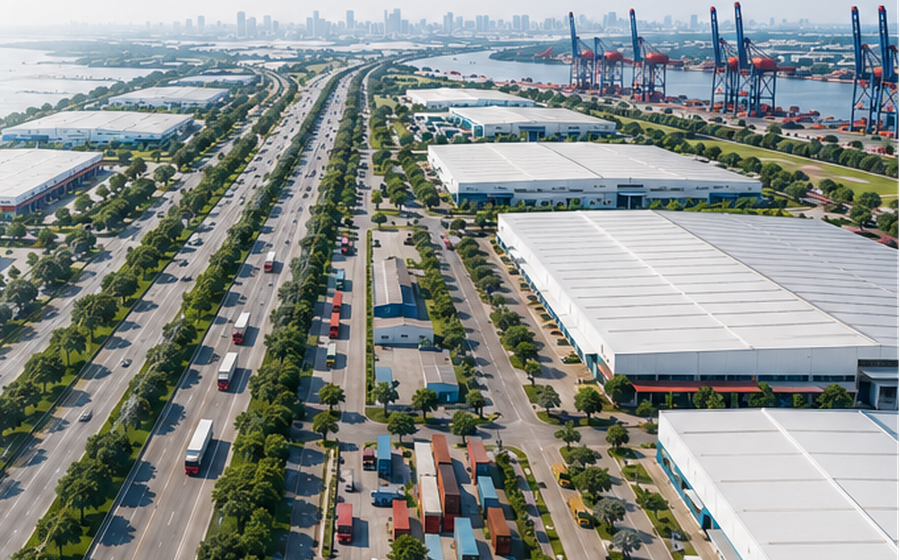
Ho Chi Minh City has long served as the country’s commercial, financial, and talent hub. Dong Nai has emerged as one of Vietnam’s largest manufacturing bases, supported by extensive industrial park networks and strategic connectivity. Meanwhile, Ba Ria – Vung Tau has played a vital role as the region’s international maritime gateway, anchored by the Cai Mep – Thi Vai deep-sea port system.
While these markets have individually demonstrated strong growth, development has often been shaped by separate planning frameworks and administrative boundaries.
The new regional structure creates an opportunity to integrate these strengths into a single economic ecosystem – connecting urban services, industrial production, and global logistics infrastructure more efficiently than ever before.
A New Approach to Industrial Site Selection
As industrial land supply in core markets becomes increasingly constrained and occupancy costs continue to rise, manufacturers are expanding into surrounding locations in search of scalable solutions.
However, at NAI Vietnam, we believe that industrial occupiers should move beyond traditional site selection criteria focused solely on land cost.
Instead, companies should evaluate locations based on total operating efficiency and long-term competitiveness.
Key considerations include:
- Actual transit time to Cai Mep – Thi Vai Port, Cat Lai Port, and major airports;
- Future infrastructure improvements, including Ring Roads 3 and 4, Bien Hoa – Vung Tau Expressway, and Long Thanh International Airport;
- Access to labor pools and commuting patterns across the wider metropolitan area;
- Availability and scalability of utilities to support future expansion.
In today’s environment, a lower land rental rate may not necessarily translate into lower operating costs if it results in longer logistics lead times, labor shortages, or congestion-related disruptions.
Infrastructure Connectivity Will Be the Defining Advantage
The integration of Ho Chi Minh City, Dong Nai, and Ba Ria – Vung Tau is expected to accelerate infrastructure coordination across the region.
Projects such as Long Thanh International Airport, the Bien Hoa – Vung Tau Expressway, and the expansion of regional ring roads are set to strengthen connectivity between inland manufacturing clusters and deep-sea ports.
For export-oriented manufacturers, this could lead to:
- Reduced transportation costs;
- Improved inventory turnover;
- Greater supply chain resilience;
- Faster access to international markets; and
- More efficient movement of goods and workforce.
From a commercial real estate perspective, industrial assets positioned along these strategic infrastructure corridors are likely to benefit from stronger occupier demand and long-term value appreciation.
What This Means for Occupiers and Investors
The emergence of a unified Ho Chi Minh City economic region has the potential to create a new industrial growth corridor for Southern Vietnam.
For occupiers, the opportunity lies in optimizing manufacturing footprints across a broader and better-connected region. For investors and developers, the integration could unlock new industrial investment destinations supported by enhanced infrastructure and stronger regional planning.
As an industrial real estate advisor, NAI Vietnam believes that the future winners will be companies that align their real estate strategies with evolving infrastructure networks and regional economic integration.
In a market where connectivity increasingly drives competitiveness, industrial location decisions are no longer simply about where to operate today – they are about where growth will occur tomorrow.